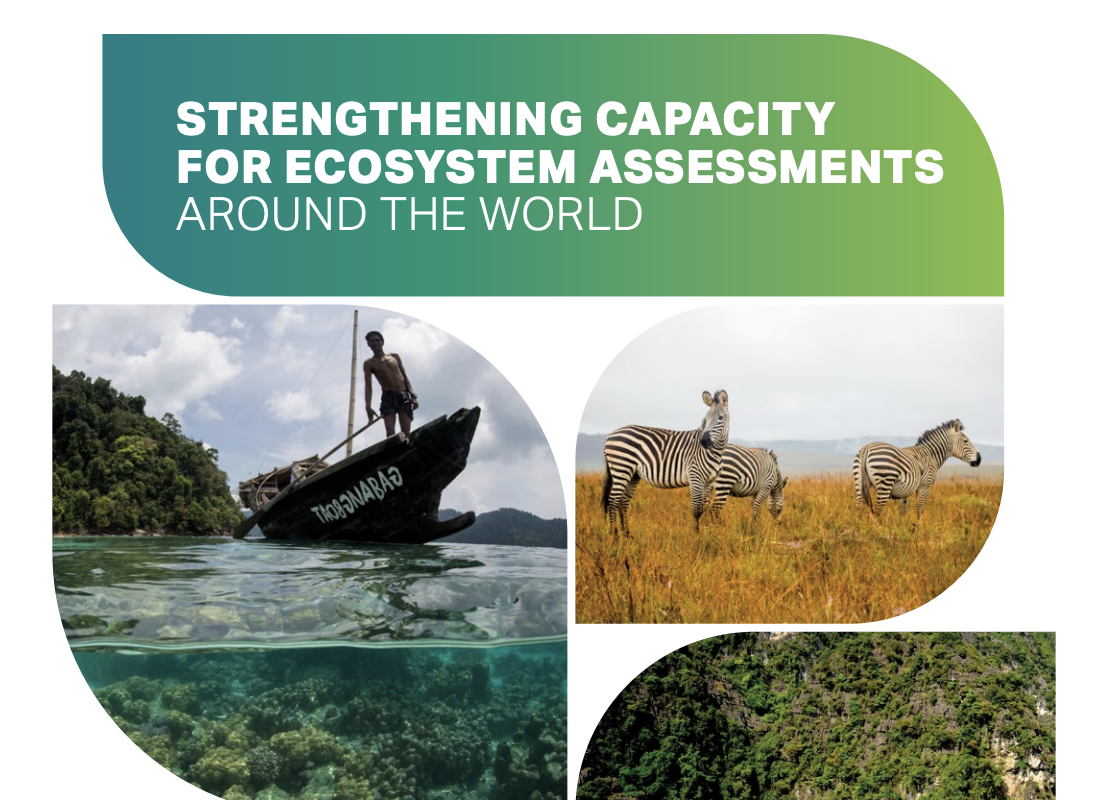
Mainstreaming the conservation and sustainable use of biological resources across all sectors of the national economy, society and policy-making frameworks is a complex challenge. It is critical to have a clear understanding of the linkages, impacts and dependencies of human activities on ecosystems. Society’s interdependence with nature is revealed clearly when we focus attention on ecosystem services. Examining ecosystem services can therefore be used to support mainstreaming efforts and to inform development planning and decision-making. Yet identifying, recording, explaining and understanding these linkages remains a major challenge. Ecosystem service assessments and valuations (ESAVs) are often commissioned, designed and conducted in ways that that do not achieve their full potential in terms of practical usefulness and policy relevance.
This report was produced as a collaborative exercise between a number of conservation and development researchers, planners and practitioners, based on their own experience with studying, conducting and/or commissioning ESAVs. It also draws on a review of cases studies from the literature, research, as well as from various on-the-ground initiatives (TEEB, ProEcoServ, CSF, ValuES). The structure, format, content and illustrative case studies to be included in the paper were discussed and agreed at a workshop on the requirements and options for increasing the policy impact of ESAVs, held in Frankfurt in November 2014 and, hosted by the ValuES project.
Three requirements for increasing the policy impact of ESAVs have been identified:
- Balance the trio of credibility, legitimacy and relevance: These key principles for scientific policy advice should guide the ESAV design and process management. However, there are tensions between them which merit attention.
- Close the loop between ESAV and policy: The assessment process needs to be linked clearly to public and private policy-making. Numbers rarely speak for themselves, and without an adequate grounding and links to policy processes, ESAV results will likely be ignored, or – worse – misunderstood.
- Tailor ESAV to its practical purpose: Many different approaches and methods are available which can be used to conduct ESAVs. Study design is not merely a matter of choosing the “best” technical method. To be effective and convincing, ESAVs have to be appropriate and relevant to their practical purpose and intended decision-making target.
There is a great deal of variation in ESAV purposes, contexts and methods. It therefore follows that there is no standard or “one size fits all” assessment approach. To be fit-for-purpose an ESAV often has to go through a series of discussions, negotiations and collective reasoning processes between key players.